

Understanding Your Home’s Cooling System
How does air conditioning work? It’s a question most Australians have pondered while flicking on their air conditioner on a scorching summer day, yet few truly understand the fascinating process that transforms hot air into that refreshing cool breeze. While millions of us rely on air conditioning daily, the science behind this essential technology remains a mystery to many.
This comprehensive guide demystifies air conditioning systems, explaining everything from the refrigeration cycle to the different types of cooling systems available for Australian homes. Whether you’re considering a new installation or simply curious about the technology keeping you comfortable, understanding these fundamentals will help you make smarter decisions and save money on energy bills.
The Brief History of Air Conditioning in Australia
From Luxury to Necessity
Modern air conditioning began with Willis Carrier’s groundbreaking invention in 1902, which revolutionised climate control technology worldwide. What started as an industrial solution for controlling humidity in printing plants eventually made its way to Australian shores, where the country’s demanding climate created perfect conditions for widespread adoption.
Throughout the 1970s, air conditioners transitioned from luxury items reserved for commercial buildings to essential household appliances, driven by Australia’s hot summers and increasingly affordable technology.
Australian standards and energy efficiency requirements have significantly shaped how air conditioning systems are designed and manufactured today. The introduction of star ratings and minimum energy performance standards has pushed manufacturers to develop increasingly energy-efficient models that suit our unique climate conditions, from the humid coastal regions to the dry inland heat.
Need Expert Help Choosing Your System?
Not sure whether split system or ducted air conditioning is right for your home? Our team specialises in air conditioning systems tailored to Australian homes. Call us today – 0480 808 422
How Does Air Conditioning Work? The Refrigeration Cycle Explained
The Science of Moving Heat, Not Creating Cold
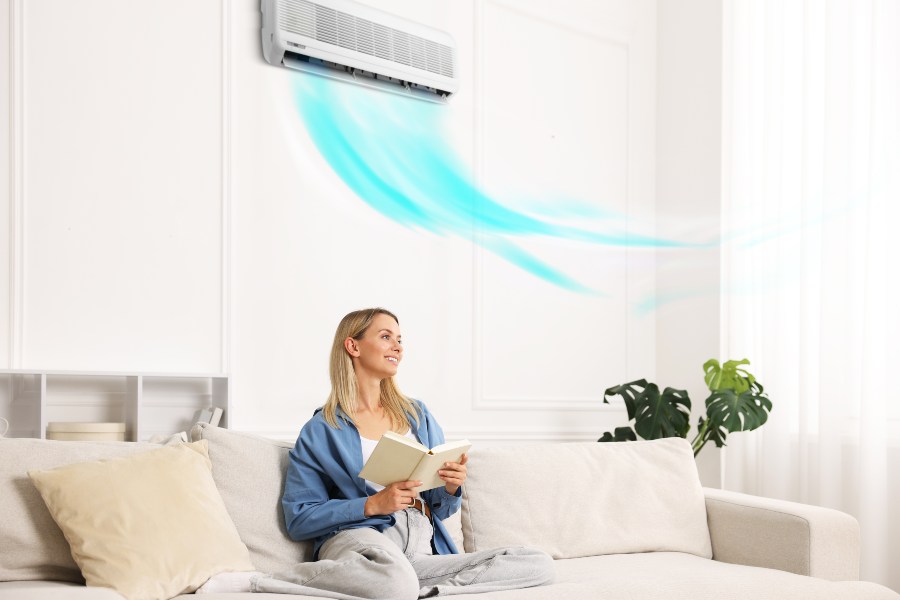
Here’s the fundamental principle many people misunderstand: air conditioners don’t actually create cold air; they remove heat. This distinction is crucial to understanding how air conditioners work. Every air conditioning system, regardless of type or brand, operates on the refrigeration cycle, a continuous process that relies on a special liquid refrigerant that changes state from liquid to gas and back again.
These phase changes allow the refrigerant to absorb heat from one location and release it in another, much like a heat delivery truck constantly picking up unwanted heat from your living spaces and dumping it outside.
The process creates a continuous cycle: heat is absorbed from indoor air, transported via refrigerant to the outdoor unit, expelled into the outside air, and then the cycle repeats endlessly. This same clever process can be reversed in reverse-cycle air conditioners, allowing them to absorb heat from outdoor air even on cold days and bring it inside to warm your home during winter.
The Four Essential Stages Every AC Goes Through
The refrigeration cycle consists of four distinct stages that work in perfect harmony to cool your indoor environment. Understanding these stages reveals exactly how air conditioners work to maintain your desired temperature.
- Stage 1 (Evaporation): Inside your home, cold, low-pressure liquid refrigerant sits in the evaporator coil within the indoor unit. As the blower fan blows air across these cold evaporator coils, the refrigerant absorbs heat from the ambient air and boils into a refrigerant gas. The now-cool and dehumidified air is blown back into the room, while moisture that condensed on the coils drains away, improving indoor air quality.
- Stage 2 (Compression): The refrigerant gas travels through pipes to the outdoor unit, where it meets the compressor, the powerhouse of any air conditioner unit. The compressor squeezes the gas hard, dramatically increasing its pressure and temperature. This compression process is essential because it concentrates the heat absorbed from your indoor space into a smaller volume, preparing it for the heat release stage.
- Stage 3 (Condensation): The hot, high-pressure gas now flows through the condenser coil in the outdoor unit. A fan blows outdoor air across these coils, and the refrigerant releases all its heat absorbed from inside your home. As it sheds this unwanted heat, the refrigerant condenses back into a high-pressure liquid. This is why you feel warm air blowing from your outdoor unit; it’s your home’s excess heat being expelled.
- Stage 4 (Expansion): The high-pressure liquid passes through a tiny expansion valve, experiencing a rapid pressure drop that causes its temperature to plummet. The refrigerant returns to a cold liquid form, intensely cold and ready to flow back to the evaporator coil inside. The cycle repeats continuously while your air conditioning system operates, maintaining a comfortable temperature throughout your enclosed space.
The Four Key Components Making It All Happen
Meet the Hardworking Parts Inside Your System
Four main components work together as a team to execute the refrigeration cycle, each playing a critical role in removing heat from your home.
- The Evaporator Coil sits inside the indoor unit and is where the cooling magic happens. This heat exchanger is where the liquid refrigerant absorbs heat from your indoor air. As warm air flows across the cold evaporator coils, the refrigerant boils into a gas while simultaneously dehumidifying the air. Moisture condenses on these coils and drains away, which is why regular filter cleaning matters. Clogged filters restrict airflow, forcing the fan and motor to work harder and reducing energy efficiency.
- The Compressor is the heart of any air conditioning system, located in the outdoor unit. This powerhouse component does the heavy lifting by compressing the refrigerant gas, dramatically increasing both its pressure and temperature. It’s the most critical and expensive component in your system, and that familiar humming sound you hear outside is the compressor hard at work. Modern inverter compressors can adjust their speed based on cooling demand, offering significant energy-saving benefits.
- The Condenser Coil, also in the outdoor unit, acts as the heat exchanger that releases absorbed heat to the outside air. A large fan pulls outdoor air across the coil, allowing the hot refrigerant to shed its heat and condense back into liquid form. The location, airflow, and cleanliness of this component are critical. Blocked coils from leaves, dirt, or debris force the entire system to work much harder, driving up running costs and risking breakdown.
- The Expansion Valve is small but absolutely critical. This component rapidly cools the refrigerant by forcing the high-pressure liquid through a narrow opening, causing a sudden pressure drop. It regulates refrigerant flow between components and essentially resets the system for the next cooling cycle, ensuring the refrigerant returns to the evaporator coil at the perfect temperature and pressure.
Keep Your AC Components Running Like New
Now that you understand how critical each component is, ensure yours are performing at their best. Our comprehensive air conditioning cleaning service removes built-up dust and debris from evaporator coils, condenser coils, and filters. Contact us today – 0480 808 422
Split System vs Ducted: Different Types, Same Core Process
Split System Air Conditioning Explained
Split system air conditioners consist of two separate units: an indoor unit mounted high on a wall and an outdoor unit positioned on the ground or a bracket outside. Despite being separated, both units work together running the same refrigeration cycle. The indoor unit contains the evaporator coil and blower fan, while the outdoor unit houses the compressor and condenser coil. Refrigerant lines and electrical cables connect these components, allowing refrigerant flow between them.
Split system air conditioners are best suited for single rooms, targeted cooling in specific areas, apartments, or adding air conditioning to existing homes, room by room. Single-split systems connect one indoor unit to one outdoor unit, while multi-split systems allow multiple indoor units to share one outdoor unit, which is ideal when outdoor space is limited.
Ducted Air Conditioning: The Whole-Home Solution
Ducted systems feature a central air handler concealed in the ceiling cavity or roof space that distributes conditioned air through insulated ductwork to discreet vents or grilles in multiple rooms. The same refrigeration cycle applies but operates on a larger scale, with a powerful central location system conditioning air for your entire home. These cooling systems excel at maintaining consistent temperatures throughout living spaces without the visual impact of wall-mounted units.
Split System vs Ducted: Quick Comparison
| Feature | Split System Air Conditioners | Ducted Systems |
| Best For | Single rooms, apartments, targeted cooling | Whole homes, new builds, seamless aesthetic |
| Installation Cost | Lower upfront investment | Higher initial cost |
| Visibility | Wall-mounted indoor unit visible in each room | Only discreet ceiling vents are visible |
| Control | Individual room temperature control | Zoned control across the entire home |
| Flexibility | Easy to add room-by-room over time | All-in installation required |
| Whole-Home Efficiency | Multiple units are needed, less efficient for the entire home | Superior energy efficiency for larger homes |
| Space Required | Minimal (wall space for indoor unit) | Ceiling cavity space for ducts and air handler |
Both split system air and ducted air conditioning use the same refrigeration cycle and can include reverse cycle capability for year-round comfort. Your choice depends on your home’s layout, budget, and whether you need targeted cooling or whole-home climate control.
What “Reverse Cycle” Really Means
Reverse cycle air conditioners aren’t a separate system type but rather a valuable feature that most modern Australian air conditioning systems now include. These versatile heat pump systems can reverse the refrigeration cycle’s direction. In heating mode, the system absorbs heat from cold outdoor air (even frigid air contains heat energy) and releases it inside to warm your home. The process works because the refrigerant can extract more heat from outside air than conventional heating systems generate, making reverse cycle air conditioners remarkably energy efficient.
This heating energy efficiency gives reverse cycle air conditioners a significant advantage over traditional electric or gas heaters. Rather than generating heat from scratch, they simply move existing heat from one place to another, consuming far less electricity in the process. Available in both split system air and ducted configurations, reverse cycle technology has become the standard for year-round comfort in Australian homes.
Energy Efficiency: Why Understanding AC Operation Saves You Money
Decoding Star Ratings and Running Costs
Energy star ratings on air conditioners aren’t marketing fluff; they’re government-regulated guides directly impacting your electricity bills. More stars mean lower running costs for the same cooling output.
Understanding key technical terms helps you choose wisely:
- Kilowatt (kW) capacity refers to cooling output, not electricity consumption.
- EER (Energy Efficiency Ratio) for cooling
- COP (Coefficient of Performance) for heating
This tells you how many kilowatts of cooling or heating the system produces per kilowatt of electricity consumed.
Consider this comparison: a 3-star rated unit might have a COP of 3.5, producing 3.5kW of heating energy for every 1kW of electricity. A 5-star unit with a COP of 5.0 produces 5kW of heat for that same 1kW of electricity. Over an Australian summer or winter, this difference translates to hundreds of dollars in savings.
With heating and cooling accounting for approximately 46-51% of household energy bills (depending on climate and heating fuel type), choosing an energy-efficient model becomes a crucial investment. However, even the most efficient air conditioner won’t perform to its rating without proper sizing and professional installation.
How Proper Sizing Affects System Performance
Correct sizing is absolutely non-negotiable for achieving the energy efficiency and comfortable temperature promised by manufacturers. Undersized units run constantly on hot days, never quite reaching your desired temperature while placing enormous strain on the compressor. They consume excessive electricity, delivering inadequate cooling, leading to premature component failure.
Oversized units create equally problematic issues through “short cycling”. They cool the indoor space too quickly, shut off, then restart minutes later. This pattern wastes energy because the compressor uses a massive power surge every startup, and the system never runs long enough to properly dehumidify, leaving occupants feeling cold and clammy.
Professional technicians perform detailed heat load calculations considering room dimensions, ceiling height, window size and orientation, insulation quality, local climate, and occupancy patterns. West-facing windows, for example, allow significantly more heat into living spaces than other orientations. DIY sizing using online calculators almost always results in incorrect sizing, poor performance, and higher lifetime costs.
Keeping Your System Running Efficiently: Maintenance Basics
Regular maintenance preserves the efficiency and performance discussed throughout this guide while maximising system lifespan. Understanding how air conditioners work makes it clear why certain maintenance tasks are so critical. Each component in the refrigeration cycle depends on the others functioning properly. Neglecting simple maintenance not only reduces energy efficiency but can also lead to costly breakdowns that could have been easily prevented.
Essential Maintenance Tasks for Homeowners:
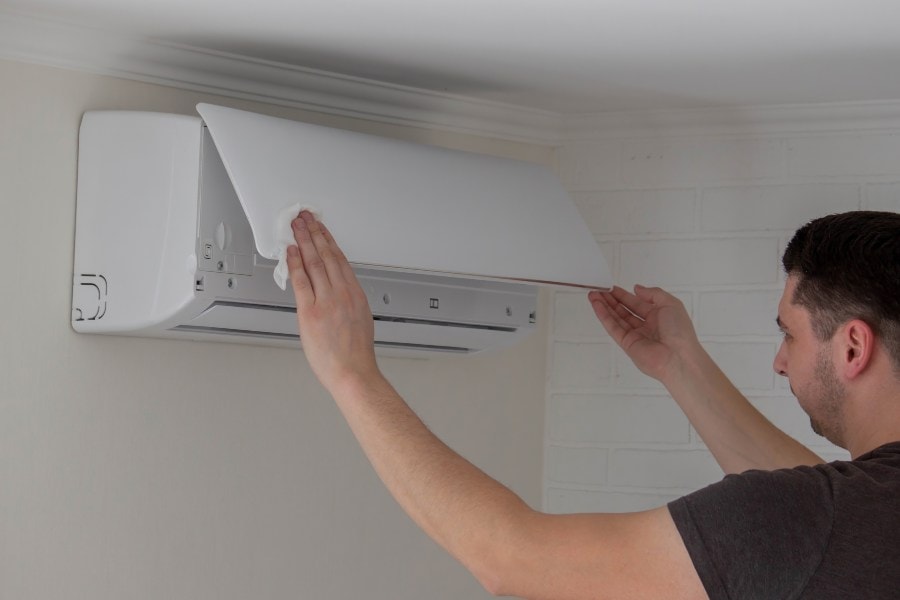
- Clean or replace filters monthly during heavy use periods: Filter cleaning stands as the single most important homeowner task. When filters clog with dust and debris, airflow through the indoor unit becomes severely restricted. The blower fan must work much harder to pull air across the evaporator coil, resulting in higher power bills and noticeably reduced cooling performance. This simple 5-minute task significantly improves energy efficiency.
- Keep the outdoor unit clear of debris: Regularly remove leaves, grass clippings, spider webs, and debris from around the unit. Trim vegetation that might restrict airflow, ensuring the condenser coil can breathe freely. If the condenser can’t expel heat effectively to outside air, the entire refrigeration cycle becomes less efficient, running costs increase, and component life shortens.
- Ensure proper airflow around both units: Make sure furniture, curtains, or other objects don’t block the indoor unit’s air intake or output. Similarly, maintain at least 30cm clearance around the outdoor unit for optimal performance.
These simple maintenance tasks ensure your cooling systems operate at peak efficiency, maintaining optimal indoor air quality and comfortable temperature throughout your home. However, there’s a clear line between homeowner maintenance and work requiring professional expertise.
When to Call a Licensed Professional
While basic maintenance can be handled by homeowners, certain warning signs indicate it’s time to contact a qualified technician. Recognising these symptoms early can prevent minor issues from becoming expensive system failures.
Warning Signs Requiring Professional Help:
- Inadequate cooling despite clean filters and clear outdoor units: Often indicates refrigerant leaks, which require immediate professional attention as the refrigerant absorbs heat less effectively when levels are low.
- Strange noises from the outdoor unit: Grinding, squealing, or loud clanking sounds suggest fan motor or compressor problems that need expert diagnosis and repair.
- Water dripping or pooling inside your home: Signals blocked condensate drains that must be professionally cleared to prevent water damage.
- Ice forming on indoor coils: Points to airflow or refrigerant issues affecting the evaporator coil’s ability to function properly.
- System cycling on and off frequently: Short cycling often indicates an oversized system, thermostat problems, or refrigerant issues.
- Unusual odours when the system runs: Can indicate mould growth in ducts, burnt wiring, or other serious problems requiring immediate attention.
Australian law requires ARCtick licensed technicians for any refrigerant work and licensed electricians for electrical components. Attempting DIY refrigerant work or electrical repairs is illegal and genuinely dangerous, carrying electrocution risks, potential refrigerant exposure, immediately voiding manufacturer warranties, and incurring heavy fines from authorities like SafeWork NSW. Annual professional servicing catches small issues before they become expensive failures.
A professionally installed and properly maintained air conditioning system should last 10 to 15 years, with coastal installations potentially facing shorter lifespans due to salty air corrosion, making regular professional maintenance a worthwhile investment in longevity.
Is Your System Costing You More Than It Should?
Our air conditioning repair service diagnoses and fixes efficiency issues, refrigerant leaks, and component failures before they become expensive replacements. See our service areas and give us a call today – 0480 808 422
Why Understanding Your Air Con Matters for Australian Homeowners
Understanding how air conditioning works empowers Australian homeowners to make smarter decisions. You can choose the right system type and features that match your needs and budget, recognise quality installation practices, maintain your system properly, and know when to call professionals. This knowledge saves money on running costs and prevents expensive, premature repairs.
While the refrigeration cycle remains the same whether it’s split system air conditioning in a Sydney apartment or ducted systems in a Central Coast home, performance and longevity depend on three critical factors: professional sizing, expert installation by licensed technicians, and consistent maintenance.
At CB Climate Control, our licensed experts serve homes across the Central Coast, Sydney, and Newcastle with years of experience in all types of cooling systems. Whether you need advice on split system air conditioners versus ducted systems, professional installation, or annual maintenance, we’re here to help. Contact CB Climate Control today for year-round comfort and energy-efficient operation.


