


The Origins of Air Conditioning – A Brief History Of Cool and Comfort
Air conditioning transformed everyday life and work by allowing people to manage indoor temperature and humidity almost independently of the weather outside. For anyone wondering “when was air conditioning invented?“, its modern form took shape in the early 20th century, as advances in mechanical engineering began to intersect with the demands of rapidly industrialising cities, dense office buildings, and heat-sensitive processes.
What first emerged was not a luxury system meant to keep people cool, but a tightly controlled method for conditioning air to meet precise industrial requirements. Early air conditioning installations were designed to stabilise temperature, reduce moisture in the air, and improve the consistency of manufacturing environments, ensuring that materials behaved predictably and that machinery could operate within strict tolerances.
Comfort cooling for homes, offices, and public spaces only followed later, built on the same principles originally developed to solve these highly practical engineering and production challenges.
When Was Air Conditioning Invented?
The development of modern air conditioning systems began in the early 20th century when careful engineering met practical industrial needs. What emerged was a system designed not for comfort, but for precision in manufacturing and control of air properties like temperature and humidity.
The first air conditioning system was invented in 1902 by Willis Haviland Carrier, an American engineer who designed a system to regulate temperature and humidity for a printing company in Brooklyn, New York. That invention marked the beginning of modern air conditioning as it is known today.
Before the advent of the first air conditioner and eventually the Carrier air conditioning company, people relied on natural ventilation, shaded structures, and rudimentary cooling methods like evaporative systems and ice storage to keep interiors comfortable. These early approaches set the foundation for later advances that made mechanical cooling practical and efficient.
Need Efficient Cooling for Business or Commercial Space?
Large spaces demand powerful, reliable climate control. Our commercial air conditioning service Sydney solutions deliver robust HVAC installations and maintenance for commercial environments. Call today – 0480 808 422
Willis Carrier and the 1902 Breakthrough
In July 1902, Willis Haviland Carrier, then 25 years old, designed what is widely recognised as the first modern air-conditioning system. He applied principles of psychrometry, the study of the thermodynamic properties of moist air, to stabilise indoor air conditions. His design used chilled coils to cool air and remove moisture through condensation.
Carrier’s invention of the air conditioner fundamentally changed how air environments could be managed. Rather than focusing on human comfort, he aimed to solve an industrial problem of production consistency. He later refined these concepts while pursuing his master’s degree at Cornell University, where he deepened his understanding of thermodynamics and aerodynamics.
By 1915, Carrier co-founded the Carrier Engineering Corporation, advancing the technology into homes, theatres, and offices. This transition from industrial use to public application is now often seen as the true beginning of modern air conditioning.
Origins at the Buffalo Forge Company
The first major step toward the invention came during Carrier’s employment at the Buffalo Forge Company in New York. The firm manufactured heating and ventilation equipment, and its engineering culture encouraged experimentation. It was here that Carrier, assigned to improve production at a local printing plant, devised his new system.
The company provided the mechanical infrastructure he needed to test early models. Engineers at Buffalo Forge supplied materials, compressors, and ductwork that allowed realistic trials.
Carrier’s early setup included fans, heating coils, and water sprays to humidify or dehumidify the air. This allowed him to control both the temperature and humidity of the air entering the factory space precisely. This combination of engineering resources and scientific reasoning marked the shift from simple cooling to controlled air processing.
Humidity Control and Printing Innovation
The specific problem that led to the invention of the modern air conditioner was the control of humidity in a Brooklyn printing plant to prevent paper distortion and misalignment of colored inks. Moisture changes caused the paper to expand or contract, misaligning coloured inks during printing. The carrier’s design reduced these fluctuations by cooling the air until excess water vapour condensed out.
His humidity control system offered stable temperature and consistent moisture levels, which improved print quality and production speed. The results were so effective that similar systems spread quickly to other industries dealing with moisture-sensitive materials, such as textiles and tobacco.
Over time, Carrier learned that precise humidity management also enhanced comfort and air quality. This understanding eventually guided the evolution of air conditioning from industrial machinery into residential and commercial climate control systems used worldwide.
The Invention of Air Conditioning – Early Cooling and Refrigeration
Cooling technologies evolved from simple reliance on natural elements to advanced mechanical systems that eventually enabled precise temperature control. Progress in refrigeration, air flow management, and refrigerant technology laid the foundation for air conditioning as it is known today.
Ancient Cooling Methods
Long before the invention of the convenient window air conditioner, ancient civilisations used natural cooling approaches to manage indoor temperatures. In Egypt, people hung wet reeds over windows so that airflow produced a mild cooling effect through evaporation. Romans used aqueducts to circulate cool water through wall channels, while Persians built windcatchers and underground storage areas called yakhchals to preserve ice and airflow in hot desert climates.
Across Asia, early architectural design promoted passive ventilation. Buildings were positioned to take advantage of breezes, shaded courtyards, and thick stone walls that absorbed daytime heat and released it slowly overnight. This environmental awareness reflected an intuitive understanding of heat transfer and insulation principles.
These early solutions used no artificial refrigerants or machinery. Still, they demonstrate how societies manipulated air flow, temperature, and humidity long before the mechanical age. Each culture contributed different innovations that influenced later developments in controlled refrigeration and ventilation.
Development of Mechanical Refrigeration
By the 18th century, scientists began exploring refrigeration principles. In 1748, William Cullen demonstrated artificial refrigeration through evaporative cooling by evaporating liquids under a vacuum, producing a cooling effect; however, his method was not practical for everyday applications. In 1834, Jacob Perkins patented the first practical vapour-compression refrigeration system, using ether as the working fluid. This closed-cycle system laid the groundwork for modern refrigeration technology.
Engineers refined compressor designs and experimented with various refrigerants such as ammonia and sulphur dioxide. These substances absorbed and released heat efficiently but were often toxic or corrosive. The rise of industrial production in the late 19th century, particularly in food preservation and breweries, encouraged wider adoption of mechanical refrigeration systems.
By the early 1900s, refrigeration units began to influence indoor air control, marking the transition from basic cooling of stored goods to maintaining comfort in occupied spaces. Mechanical refrigeration provided the technological backbone on which modern air conditioning depended.
Key Predecessors to Modern Systems
The path to modern air conditioning involved incremental advances that integrated refrigeration, humidity control, and ventilation design. Early theatre and building systems in the late 19th century modified existing heating ducts to circulate cooled air, though temperature distribution remained uneven. Patrons often experienced cold air near the floor and muggy air above, revealing the need for better air mixing.
In 1902, engineer Willis Haviland Carrier introduced a breakthrough system that regulated both temperature and humidity using a redesigned vapour-compression process. His centrifugal compressor, developed in 1922, significantly increased efficiency and reliability. This innovation marked the origin of the modern air conditioning industry.
Other inventors, including Stuart Cramer and Alfred Wolff, contributed to humidity control and large-scale ventilation systems. Their work shaped the engineering discipline that today informs commercial and residential air conditioning design. Together, these advancements connected mechanical refrigeration with the science of environmental comfort.
Keep Your Home’s Air Clean and Healthy
Protect your family’s health with professional air conditioning cleaning that removes hidden dust and mould, backed by thorough evaporative cooling service checks and ducted air conditioner service to keep every room comfortable year-round. Contact us – 0480 808 422
The Invention of Air Conditioning – Modern Air Conditioning Technology

Modern air conditioning systems have advanced from simple mechanical cooling units to efficient climate control technologies that balance comfort, energy use, and environmental impact. Key developments include improvements in refrigerants, innovations in system design, and the steady expansion of air conditioning in homes and workplaces.
What is a Modern Air Conditioner?
A modern-day air conditioner is essentially an apparatus for treating air: it draws in warm indoor air, conditions it, and then uses a fan and ductwork or vents to deliver cold air back into the space. At its core are components such as the evaporator coil, an air handler that moves and blows air through filters, and an outdoor unit that releases heat. This artificial cooling is now common in homes, offices, hospital rooms, and many other environments.
Today’s home cooling systems come in many formats. There are portable air conditioners, the classic self-contained room cooler or individual room air conditioner, ductless systems that cool individual rooms, and the familiar split system room cooler pairing an indoor head with an outdoor unit. Larger commercial installations may use a cooling tower or an evaporative cooler as part of more complex energy-efficient systems.
Modern air conditioner manufacturers design equipment to reduce energy consumption and overall energy usage. Many units now incorporate heat pumps, which can both heat and cool, and automatic control system features that optimise air conditioning use. Leading air conditioning manufacturers are also integrating passive air conditioning techniques and even renewable energy sources into product and building designs to offset the urban heat island effect and support cooling cities more sustainably.
Advances in Refrigerants
Early refrigeration and air-conditioning systems commonly used refrigerants like ammonia, methyl chloride, and sulphur dioxide, which were effective but toxic and flammable, presenting safety hazards. In the 1920s and 1930s, chemists developed chlorofluorocarbons (CFCs), such as Freon (developed by Thomas Midgley Jr. and Roy Plunkett), which offered a safer, non-toxic alternative for refrigeration and air conditioning in industrial and residential applications. However, later research revealed that CFCs damaged the ozone layer, prompting international agreements such as the Montreal Protocol (1987) to phase them out.
By the late 20th century, engineers introduced hydrochlorofluorocarbons (HCFCs) and subsequently hydrofluorocarbons (HFCs), which reduced ozone depletion but still contributed to greenhouse gas emissions. The ongoing shift toward low-global-warming-potential (GWP) refrigerants, including hydrofluoroolefins (HFOs) and natural options like carbon dioxide and propane, aims to make modern systems more sustainable and energy efficient.
The change in refrigerant technology influenced the design of compressors, heat exchangers, and regulators. As refrigerant efficiency improved, cooling performance and energy ratings of air-conditioning systems also increased. Modern systems now balance cooling power with environmental responsibility.
The Rise of Central Air Conditioning
The concept of central air conditioning emerged in large commercial buildings during the early to mid-20th century. Centralised systems allowed engineers to control temperature and humidity across multiple rooms using ducted airflow and thermostatic regulation. By integrating chillers, compressors, and insulated ducts, these designs created consistent indoor climates for offices, factories, and theatres.
During the 1950s, residential architecture began adopting scaled-down versions of these systems. Advances in electric power distribution and compressor miniaturisation made installation in suburban homes more practical. Modern central systems often integrate variable-speed compressors and inverter-driven motors, which reduce power consumption by matching cooling output with demand.
Features such as zoning control, programmable thermostats, and high-efficiency filters have further refined convenience and air quality. Today, central air conditioning remains a standard for large spaces requiring even cooling and controlled ventilation.
Commercial and Residential Adoption
Initially, air conditioning served primarily industrial and commercial purposes. Willis Carrier’s 1902 system, for example, stabilised humidity for printing processes. Factories, cinemas, and department stores soon used the technology to improve worker comfort and customer experience. The 1920s and 1930s saw large urban buildings incorporating built-in cooling networks as a mark of progress and hygiene.
By the postwar decades, residential adoption accelerated as component costs fell. Compact window units became common household appliances, and builders started including central air-conditioning systems in new housing developments. Accessibility grew with innovations in split-system and ductless technologies, suitable for homes without large duct networks.
In recent years, rising temperatures and urbanisation have increased demand for efficient systems. Energy labelling, inverter technology, and smart thermostats now guide consumers toward models that reduce energy use and emissions. Both commercial and residential users continue to seek reliable climate control that maintains comfort while meeting stricter environmental standards.
When Was Air Conditioning Invented – Societal and Environmental Impact
The history of air conditioning has reshaped how people live, work, and design buildings. It has improved comfort standards while introducing new challenges tied to rising energy use, urban planning, and environmental sustainability.
Energy Consumption Challenges
Modern air conditioning units rely heavily on electricity. In many countries, cooling systems account for a large share of household and commercial energy demand, especially during extreme heat. This dependency increases strain on power grids and can lead to energy shortages during peak usage periods.
High consumption also contributes to greenhouse gas emissions. The use of refrigerants such as hydrofluorocarbons (HFCs) has raised concerns due to their global warming potential. Many governments have introduced efficiency standards and phased-down programs to reduce their environmental impact.
Key factors influencing energy use include:
- Building design: Insulation, window placement, and ventilation affect cooling needs.
- Climate: Hotter regions operate systems more frequently, driving up total energy demands.
- Technology efficiency: New inverter-based and smart cooling systems lower electricity use.
Improving ventilation and adopting passive cooling methods can reduce energy dependency. Energy labelling schemes and renewable energy integration continue to guide sustainable cooling practices in both residential and industrial sectors.
Role in Urban and Economic Development
Air conditioning has played a significant role in enabling economic productivity and urban growth. It made densely populated cities in hot climates more livable, allowing continuous activity in workplaces, shopping centres, and production facilities.
This technology expanded labour markets and supported development in sectors like IT, healthcare, and manufacturing. In large office buildings, controlled temperatures have improved comfort and reduced heat-related health risks, supporting workforce stability and performance.
However, widespread adoption has influenced urban planning and environmental design. Many modern cities rely on sealed, climate-controlled environments, which often decrease natural airflow and increase overall energy use.
Efforts to balance cooling needs with sustainability include green architecture, improved ventilation systems, and district cooling networks for energy efficiency. These approaches aim to reduce energy intensity while maintaining comfort, ensuring that air conditioning continues to support economic growth without undermining environmental goals.
The Invention of Air Conditioners – Winding It All Up
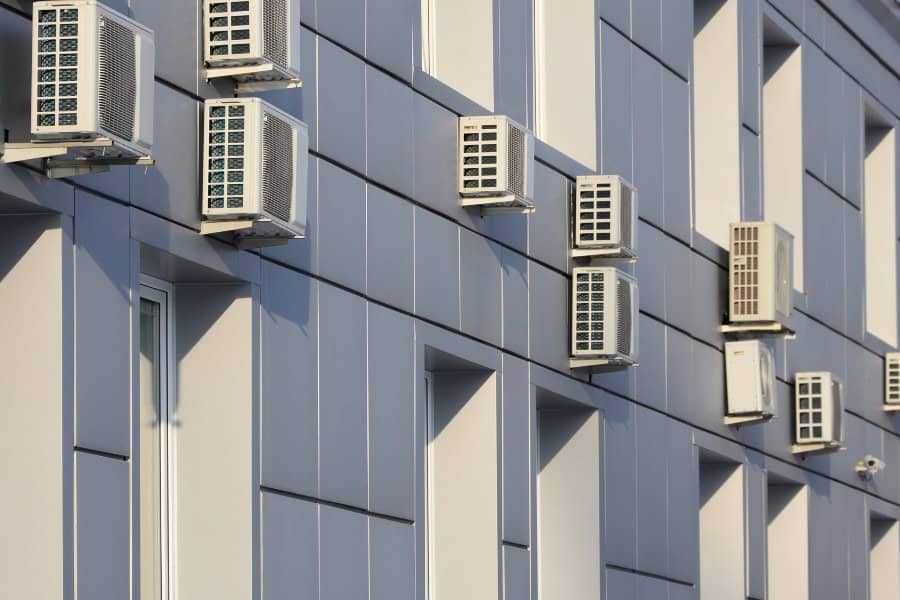
Air conditioning history is often traced to the early industrial age, when ice-making machine technology inspired experiments in artificial cooling. The first modern air conditioning system is widely credited to Willis Carrier’s invention in the northern United States: an “apparatus for treating air” that controlled temperature and humidity for a printing plant. Carrier’s system used a belt-driven condensing unit and coils; fans blew air across them to stabilise conditions.
Over time, Carrier Corporation and other air conditioner manufacturers refined this concept into reliable home and commercial solutions. Before World War II, systems were mainly installed in factories and theatres. After World War II, self-contained and split system room coolers spread into homes and offices, transforming comfort and enabling precise control of environments such as hospital rooms.
As air conditioning use expanded, so did concerns about refrigerants and pollution. Regulations such as the Clean Air Act pushed huge efficiency improvements and safer refrigerant choices. Combined with better controls and energy-efficient systems, these changes have significantly reduced per-unit energy usage. From early ice-based experiments to today’s smart, renewable-ready systems, the lineage from Carrier’s original apparatus to the modern room cooler shows how far air conditioning has come, and how central it now is to cooling cities and making hot climates livable.
Need Fast Repairs for Home or Business?
Restore performance quickly with responsive air conditioning repairs and, when needed, new split system air conditioner installation Sydney solutions that keep people comfortable in every zone. Reach out to CB Climate Control – 0480 808 422


